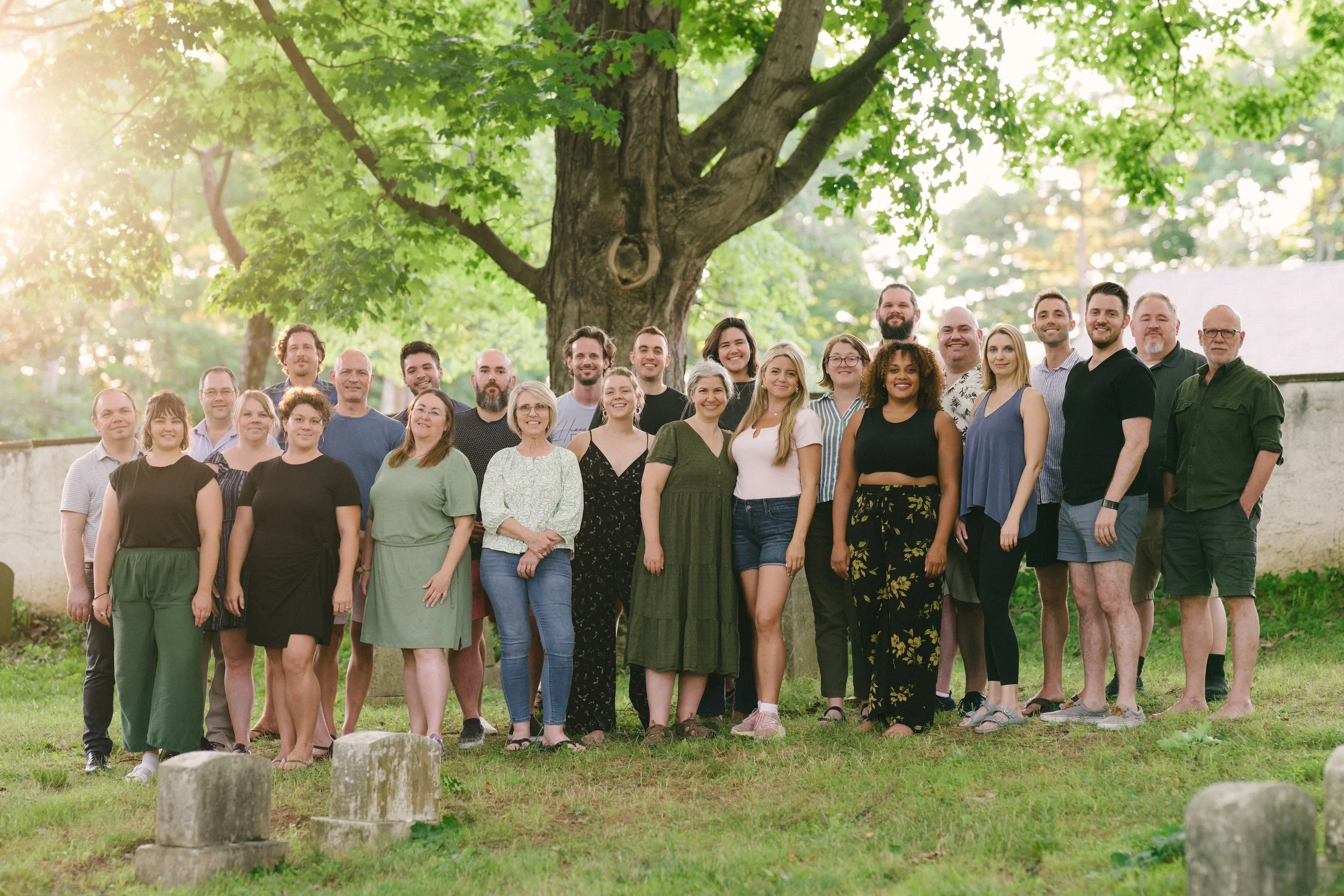
Cover Story
A New Path: Interview with The Crossing
With its Grammy awards and numerous high-profile collaborations across 20 years, what makes The Crossing a choir of its time is more about the people and the risks they are willing to take, finds Hattie Butterworth
15 August 2025 | Read at ChoirandOrgan.com
By Hattie Butterworth
‘They make me want to sing again,’ I wrote in my journal following a performance of Gabriela Ortiz’s Can We Know The Sound Of Forgiveness at Performance Garage in Philadelphia. ‘To learn complex inner parts and be part of something musically bigger.’
I had travelled from the UK to Philadelphia the day before. Late October in the city was peppered by flickering streetlamps and a commitment to Halloween that isn’t seen on the same scale in London. It’s a warm place that feels vaguely familiar – something about its constantly juxtaposed architecture and political history, as well as the feeling of relief compared to New York – which makes it seem constantly creative.
Philadelphia is a musical city. Home to the Curtis Institute, the Philadelphia Orchestra and Opera Philadelphia, it is a place pushing for new perspectives and ideas. Much like the new music ensemble which calls the city home – The Crossing.
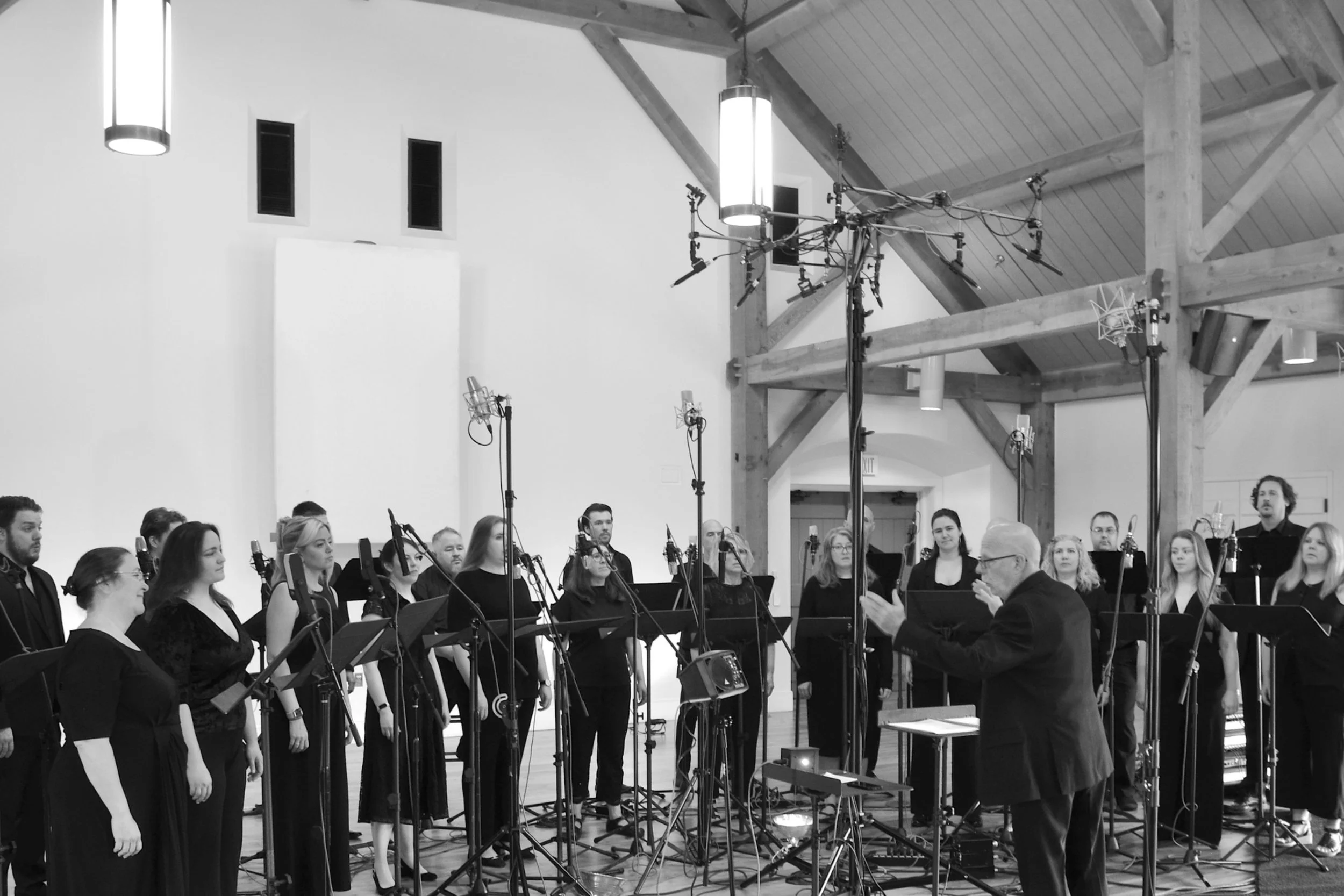
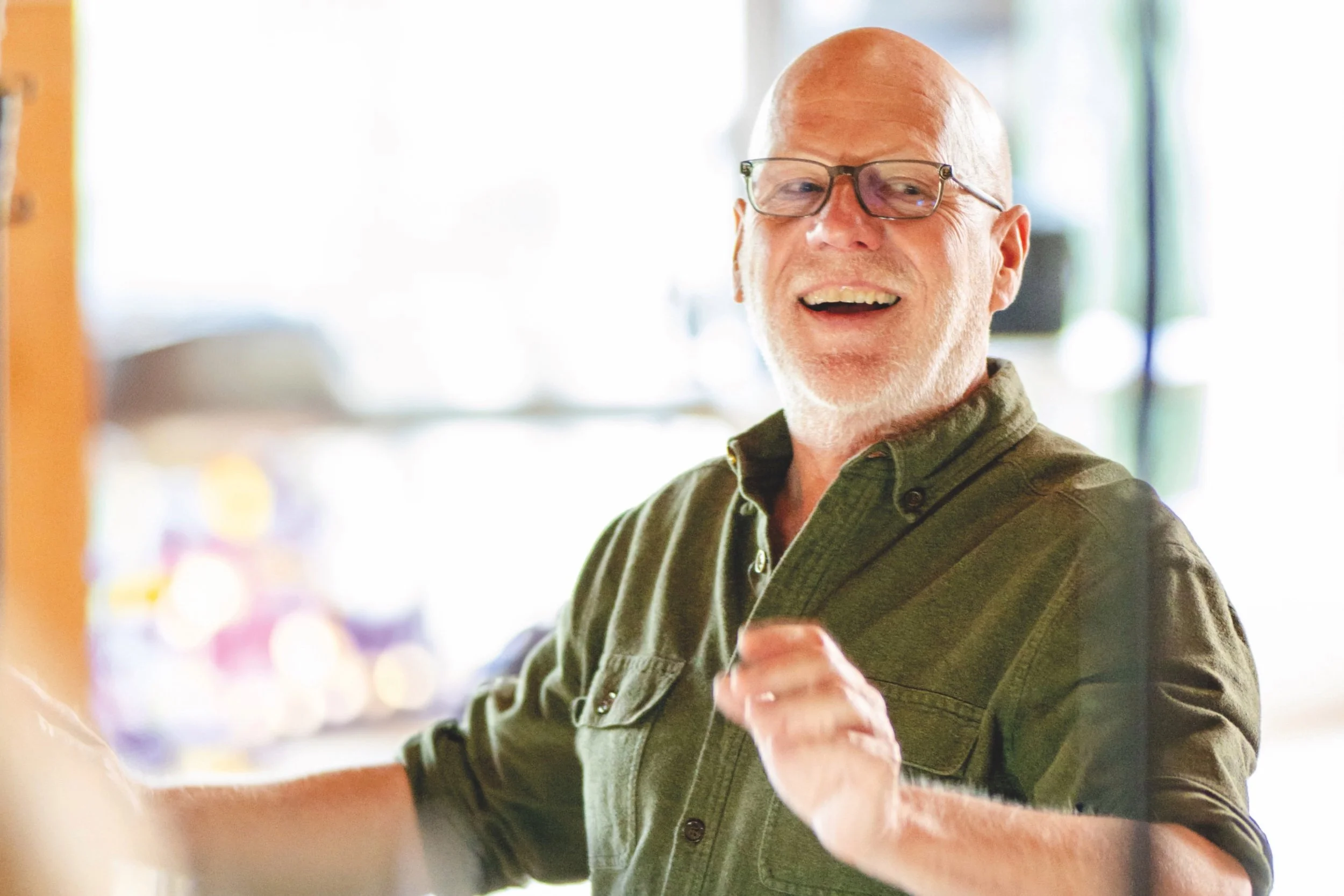
The Crossing was formed in 2005 by a group of friends and professional singers. Conductor Donald Nally had just returned from two years living in Wales and holding the position of Chorus Master for the Welsh National Opera and on his return a group of friends suggested the idea of doing a concert together. When I speak to Nally from a boardroom on Philadelphia’s Walnut Street, he is warmly nostalgic, thinking back to the choir’s formation.
‘It was only two years since I left. But people were already spread all over the place – San Francisco and Washington and Chicago, but everybody was like, “Yeah, I’ll pay for a plane ticket.” ’
That initial concert was a great success. A rave review in the Philadelphia Inquirer asked, ‘When is this going to happen again?’ The group’s co-founder Jeff Dinsmore, who died in 2014, echoed this question. The next year the group held two concerts, and the following year, three. ‘By the end of the third year, we were saying, “I think we’re on to something,” ’ says Nally.
By concert three, the group was performing exclusively new music and had commissioned ever since the first concert. Since then, it has commissioned close to 200 new works and led the ensemble to three Grammy Awards for Best Choral Performance.
In the early days, Nally tells me, the group focused a lot on modern British sacred music. ‘At the beginning of The Crossing we did a lot of that kind of stuff. And then we started to be a bit more American and a bit more complex. We started to ask, “What does it really mean to write for 24 professional voices today? Is it Jimmy [MacMillan]? Is it Judith Weir? Is it Gabriel Jackson? Is it David Lang? What is it?” ’
The group’s history reads like an introduction to new music composers and the world’s biggest ensembles. But far from limiting themselves to the grandest concert halls, the singers have become synonymous with social action and what they call a form of ‘musical journalism’. Collaboration means engaging the work of poets, such as in Harold Meltzer’s You Are Who I Love which set the poetry of Aracelis Girmay, capturing the undocumented immigrant experience in the United States. Another project, ‘The Crossing Votes: 2024’ and the former ‘The Crossing Votes: 2020’ were the group’s way of processing two complex and emotional US elections. Cloud Anthem by Michael Gilbertson with its animated video by Brett Snodgrass came from Nally’s question: ‘If we have the privilege of words and music combined to make song, what do we want to say?’
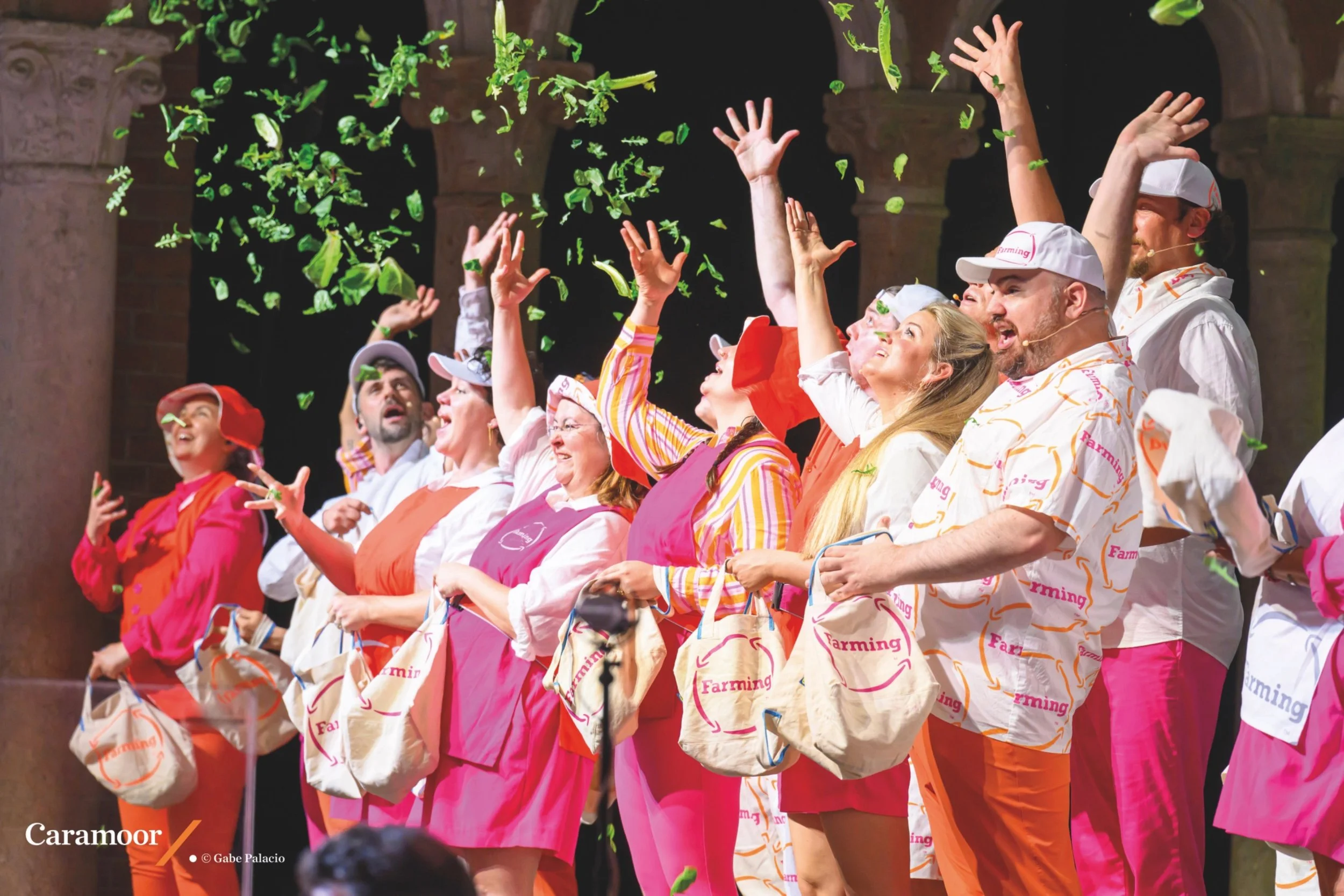
And then FARMING by Ted Hearne comes up in multiple conversations I have with The Crossing’s members. The 2023 project was scored for 24 singers, electric guitars, keyboards, percussion, and a large, cultivated field – performed at Kings Oaks Farm in Bucks County. It was developed over four years and looks at the impact of settler colonialism on current labour practices from tech to agriculture.
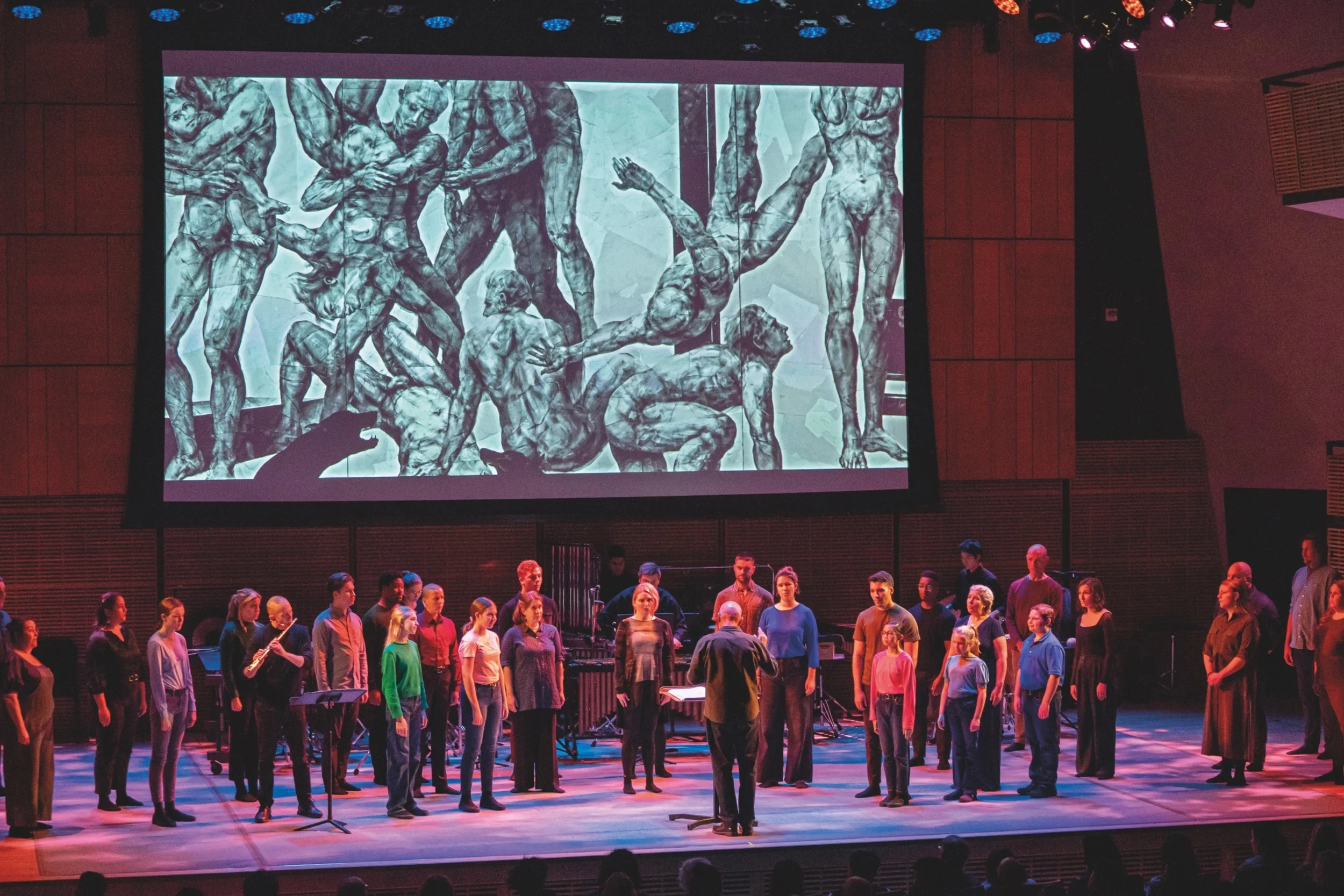
The project in motion during my trip with Gabriela Ortiz, Can We Know The Sound Of Forgiveness, was a multidisciplinary performance piece. It combined Ortiz’s music with visual art, dance, movement, and spoken word to explore the journey from violence to forgiveness and healing.
Culminating in a performance at Carnegie Hall, following the one in Philadelphia, its greatest impact for me came from Ortiz’s scoring for voice, pushing The Crossing to its absolute limits. Part of the group’s immense technical capacity allows the composers it commissions to go beyond usual vocal writing boundaries. Still, this does not mean perfection in vocal tone: it means unity of sound.
When speaking to a number of members of The Crossing prior to the concert at the Performance Garage, it becomes clear to me the rewards of The Crossing within their musical lives. A soprano in the group, Hannah Dixon McConnell, speaks in superlatives when explaining the process: ‘Every Crossing gig is something you’ve never done – or the hardest things you’ve ever done, or the most unique thing.’ Soprano Anika Kildegaard agrees, finding huge gratification in how far the singers push each other. ‘I have learned so much from my section mates about not being afraid of the ways that you might need to throw your voice around to make something happen,’ she explains. ‘We’re not trying to iron over everything. These extremes are part of what the colour of the human instrument is, and we’re not going to shy away from making those sounds.’
Of this technique, Nally says, ‘Here in America there are groups who want this really pristine, quiet sound. And so what they do is they shut the voices down to get it, but then it’s never going to be in tune. You can’t really sing in tune if you’re not really singing – you can’t express if you’re not really singing.’
Speaking about why the group works, Nally engages his own philosophy of creating art. ‘It’s the equivalent of I go out into the backyard, it’s the summertime. I put a sheet up, that’s the curtain, and I make some props out of weeds. And then I make a play – that’s our group.’
This humility and element of play is balanced by the structure of the group, which Nally is clear about the importance of. ‘We have a core and we don’t replace that core. So everybody in that core of 24 knows that they can screw up. They can take a risk. Killer musicianship is fundamental and an ability to turn it on and be incredibly raw. That’s much more important to the music that we make than beauty of voice.’
Nally was born in Hilltown, Pennsylvania, and educated at the University of Cincinnati College-Conservatory of Music with Elmer Thomas, Westminster Choir College with Joseph Flummerfelt and the University of Illinois with Don Moses.
‘Once upon a time in America, the first doctoral programme was at the University of Illinois in Urbana-Champaign, in the middle of cornfields and Harold Decker was the guy who started it,’ Nally explains this history of US choral conducting that feels a long way from that in the UK. ‘And everybody who wanted to be [Choral Director] Harold Decker went and studied there. It produced this generation of this bunch of tall white guys, and they all went off and they started their own programmes – and I studied with three of them.’
Flummerfelt became something of a mentor to Nally, remaining a friend for the rest of Flummerfelt’s life and giving Nally his first insight into the Spoleto Festival in Italy: ‘I started as a singer with the Spoleto Festival in ’85 under Flummerfelt, and then in around ’93 I became the chorus master in Italy, and I did it through ’98’. But each of his mentors gave something unique, in spite of their identical training. ‘Joe and Elmer were about sound and content, and Don was like, “Great, good: sound and content. Now get your freaking pattern clear!” ’
In Philadelphia, Nally developed the choral programme at Saint Mark’s Church in the city from 1996 to 2002, as well as running the Choral Arts Society of Philadelphia, which sang with the Philadelphia Orchestra. After his stint in Wales with WNO, Nally returned to the United States to become the chorus master for the Lyric Opera of Chicago while establishing The Crossing.
In September 2012, Nally joined the faculty of the Bienen School of Music at Northwestern University in Evanston, Illinois as a tenured professor and Director of Choral Organisations. Many of his former students now sing with The Crossing and credit Nally as being instrumental in supporting their subsequent careers. ‘When I went to Northwestern they allowed me to create what was essentially really the only new music choral programme in the country,’ Nally explains. ‘And the top choir sang almost exclusively new music. That created a unique incubator for exactly what it is we do in The Crossing.’
Speaking to one of Nally’s former students, tenor Michaël Hudetz at Northwestern, it’s clear he owes a lot to a conversation he had with Nally about his future career. ‘One day I asked Donald, “Hey, can I come talk to you? I have a lot of questions for you.” I said to him: “I don’t know what I’m doing. I don’t know how to make a living doing this.” And he very quickly said, “I’m gonna make it my project to help you.” He became such a strong mentor for me, an advocate, and still is. Because of him, I ended up going to Yale and doing a really great programme there, and it’s led to amazing things.’ Hudetz has now sung with Bach Collegium Japan and Chicago Symphony Chorus and regularly appears around the world as a tenor soloist. ‘I’ll never forget the day he walked in my office,’ Nally says of Hudetz.
Nally left his post at Northwestern in 2023 and now works as a visiting professor at Westminster Choir College. Still, I sense how much of an impact his time there had on the students and wonder how he feels now having left. ‘I miss teaching. I had only four graduate students – It was perfect for me. Those people have become such a part of my family. I miss that environment of the intensity of knowing what the five of us were doing together plus a couple of really fantastic colleagues. It meant something … But there were parts of academia that I just needed a break from.’
For its future, The Crossing is far from slowing down. Approaching its 40th album, recording projects with record label Navona are bound to produce many future Grammy nominations, with those upcoming including an album reworking 2023’s FARMING project. An album of frequent collaborator Gabriel Jackson’s choral music is also promised for this autumn, as well as new commissions from Kile Smith, Nina Shekhar and Christopher Cerrone.
I wonder how involved Nally is with the composers he commissions and the commissioning process. ‘I’m kind of obnoxiously hands on,’ he laughs. ‘I always explain to a composer who hasn’t worked with us before that I know our singers, and I know our audience. When I say “our audience”, I’m talking about that group of people that’s going to sit in that hall and hear the first version of this. And we have a lot of rehearsal time because we want that first time out to actually sound like the piece.
‘I can never just say, “Hey, just write a piece of music for us.” Because they might choose a topic or a text that my audience isn’t going to buy. We live way beyond the obvious.’
It appears to me that Nally isn’t afraid for The Crossing to be a political entity. Or something that asks difficult questions. He is not scared to call out elements to art creation that seem problematic to him: ‘There’s a real pandemic here in the United States with these composers writing these pieces that say, “War is bad and peace is good”. Oh, well thank you. Thanks.’ Nally is frustrated and sarcastic in equal measure. ‘I didn’t know that, and I needed you to write a four-minute piece for me to understand. I think that those pieces also tend to inspire this audience reaction of being moved by their own ability to be moved. I think that’s disgusting and dangerous – it has no place in my life at all.’
Part of Nally’s commitment to honesty and vulnerability was unleashed when I asked him about the emotions around being in charge and in a leadership position.
‘When I was younger I deeply regret a lot of decisions that I made as a leader of people,’ Nally grows quieter and more reflective. ‘I come from a complex family background. Many of us do, and I had a lot of anger in me. I didn’t really know that and it would come out in these inappropriate ways in front of groups. I had a lot of misguided ideas about the relationship between the person who didn’t really even get elected to be in front of the room, but wound up in the front of the room, and everybody else who is there.’
But when did it shift? ‘I’m in Cardiff and I’m looking in the mirror at a person that I don’t necessarily like,’ Nally explains about his time in the UK highlighting a lot about his working process. ‘I think that’s the worst imaginable feeling for a conductor: to stand in front of a group, to look at individuals and think, “I don’t think I respect you.” Wow. That to me is horror.
‘I’ve been in therapy since I was 19 uninterrupted,’ Nally shares. ‘When I’m teaching, one of the things that I really stress is who is in the room is everything. Everything. And if you need six tenors but you can’t find that sixth tenor who’s going to fit the bill, go with five tenors. Don’t take the sixth tenor whose ethos doesn’t fit the group.’
Nally is a technician, a teacher and a musician, but how he views himself, above all, is as a storyteller. It’s a focus that hearkens back to his extensive work within opera.
‘Storytelling is the fundamental basis of both my art and my teaching,’ Nally explains. ‘It is an extremely humbling and very noble profession that has given us our history. I’m a dramatist. There’s a theatrical and dramatic element to everything that The Crossing does. Even if it’s just a concert, there’s going to be some form of presentation. We always have supertitles so that people don’t have to stare at the programmes.’
When the Crossing appears on the stage at Carnegie Hall, each singer clearly has their own place to stand and is dressed plainly. Gabriela Ortiz’s music is layered with an addictive sparkle which The Crossing now utterly lives inside of. That rare, trance feeling of being locked in as an audience member.
It’s clearly a group of immense satisfaction and nourishment to everyone involved at each level. ‘We have a really unique community. Everybody’s being paid decently and yet at the same time, there’s an aspect of what we do that always feels like we’re making it up. I’m absolutely fascinated by the colours that choral choirs can make and what they mean to people.’ I sense maybe Nally is a philosopher above a storyteller, or maybe both concurrently. ‘It’s just the voice – there’s nothing else there.’
Part of what makes the group special is best explained by its singers, notably Hannah Dixon McConnell, who says it’s ‘the ambition of what Donald has to say with The Crossing and what he invites us into saying as well. We’re living here and we’re living now, and we are in a dialogue with our time. To put that out there in choral music I think is wonderful and remarkable and very rare.’